 Capital Kings LLC · Non-QM Mortgage Broker
Hard Money Lenders inNew York City, New York
Fix and flip, DSCR rental and new construction financing for New York City investors. We do not lend our own money, we shop your deal across a 400+ lender network and come back with real terms you can compare on total cost.
Prefer to talk it through? Call or text Micah at (281) 636-5682.
Price a New York City deal right now
Prefilled with a realistic New York City deal. Change any number and it reprices on the programs that lend in New York, with the same math as our term sheets.
Sizing your flip on the same terms as the term sheet. Get a real term sheet →
Financing a deal in New York City
In New York City, the fix and flip loans we place are for one to four family houses, and that means the outer boroughs: frame and brick two-families in the north Bronx, attached and detached houses in southeast Queens, brownstones and row houses in Brooklyn, and detached houses on Staten Island. Manhattan co-ops and condos are a different business. In New York a first flip can be priced at 10% down with 660+ credit (from 9.99%). Programs that need completed flips: 7.5% down from 9.99% with 3+ flips; 5% down from 9.99% with 5+ flips; and 100% financing from 9.50% with 2+ flips when purchase plus rehab fits under 70% of ARV.
A New York City flip is decided by paperwork as much as by price. The Certificate of Occupancy says how many legal units the house has, and the appraiser, the buyer’s lender and the Department of Buildings all go by it, not by how many doors are in the basement. Redfin has the citywide median up slightly on a year ago, with homes taking about two months to sell. The money is in a well-bought two-family with a clean C of O, renovated to sell to an owner who lives in one unit.
What a New York City deal looks like on paper
New York City example: $560,000 purchase, $120,000 rehab, $940,000 after repair value, 700 credit, first flip. The engine puts that borrower on the First Flip, 10% Down program at 9.99%. Picture a frame two-family in Wakefield in the Bronx: two kitchens and two baths, a new boiler, separate electric meters, lead-safe turnover work, and permits that match the Certificate of Occupancy. Every number below is what the instant term sheet prints for that deal, so the picture cannot contradict the page.
- Down payment (10% of purchase plus rehab)You$68,000
- Origination (2.13%)Lender$13,005
- Lender fees (flat)Lender$2,790
- Broker fee (1%)Broker$5,560
- Title and closing (Texas-rate estimate; New York adds mortgage recording tax and attorney fees)Title$5,359
- Prepaid interest (15 days)Lender$2,020
- Property insuranceInsurer$6,460
- AppraisalAppraiser$550
Interest while you rehab: $4,096 a month on the $492,000 funded at closing, $5,095 once every draw is out. Proof of funds is cash to close plus $30,000 of rehab reserve and $30,569 of interest reserve. Sample borrower, sample address; the sheet is issued by the same engine as the borrower’s instant term sheet.
Fix and flip programs in New York City
Swipe the table for rates, credit and terms →
| Program | Down payment | Min credit | Experience | Rate | Origination | Max loan | Term | Close |
|---|---|---|---|---|---|---|---|---|
| First Flip, 10% Down1 | 10% of purchase + rehab | 660+ | First flip OK | 9.99% | 2% | 75% of ARV | 12 months | 21-30 days |
| 7.5% Down, 3+ Flips2 | 7.5% of purchase + rehab | 660+ | 3+ completed flips | 9.99% | 1.5% | 75% of ARV | 12 months | 21-30 days |
| 5% Down, 5+ Flips3 | 5% of purchase | 660+ | 5+ completed flips | 9.99% to 10.99% | 2% | 75% of ARV | 9-24 months | 10-14 days |
| 100% Financing, 2+ Flips4 | 0% (100% financing) | 620+ | 2+ completed flips | 9.50% to 12.00% | 2.5% | 70% of ARV | 9 months | 7-14 days |
- Rate 9.99% with 2% to 2.25% origination by credit; more origination buys the rate down as far as 8.99%. Loans under $150,000 add 0.5% to the rate and 0.5% to the origination, under $100,000 1.5% and 1%. Under 680 credit the loan caps at 87.5% of cost. Standard interest, charged only on funds drawn. The loan is capped at a share of purchase plus rehab, the full rehab held back for draws, and the ARV must be at least 1.25 times purchase plus rehab. Processing $500, legal $1,495 and underwriting $795.
- Rate 9.99% with 1.5% to 1.75% origination by credit; more origination buys the rate down as far as 8.99%. Loans under $150,000 add 0.5% to the rate and 0.5% to the origination, under $100,000 1.5% and 1%. Under 680 credit the loan caps at 90% of cost. Standard interest, charged only on funds drawn. The loan is capped at a share of purchase plus rehab, the full rehab held back for draws, and the ARV must be at least 1.25 times purchase plus rehab. Processing $500, legal $1,495 and underwriting $795.
- Rate is set per file from 9.99%; origination about 2% plus a $995 processing fee.
- Needs 2 completed flips in the last two years and about $75,000 in verified liquidity. Rate 9.5% to 12% with 2% to 3% origination, set per file. Purchase plus rehab must fit under 70% of ARV.
Origination has a $2,000 minimum on most programs (a few lenders set a higher one, noted above) and our broker fee is 1% with a $2,000 minimum and a $10,000 maximum. These are the numbers our term sheets use as of October 2026. Strong credit, cash and a track record can price lower through specific lenders in the network.
Where New York City prices sit right now
Before we price a New York City flip, we look at where sales in the city sit today. Your block can run well above or below these numbers, so treat them as the starting point, not the answer.
Redfin puts the New York City median sale price at $900K for the three months ending September 2026, up 1.6% on a year earlier, with homes selling in about 58 days. The city’s residential transfer tax on a one to three family sale is 1% at $500,000 or less and 1.425% above it.
| Median sale price, New York City (Redfin, 3 months to Sep 2026) | $900,000 |
| Change on a year earlier (Redfin) | Up 1.6% |
| Days on market, New York City (Redfin) | 58 |
| NYC transfer tax, 1-3 family, $500,000 or less | 1% |
| NYC transfer tax, 1-3 family, over $500,000 | 1.425% |
Sources: Redfin, New York City housing market, NYC Department of Finance, Real Property Transfer Tax, NYC HPD, lead-based paint correction at turnover
How a New York City file actually gets priced
We build the ARV from renovated houses of the same type in the same neighborhood, sold in the last few months: a Bronx two-family against Bronx two-families, a Queens single against Queens singles. Citywide medians mean nothing at the block level. Appraisers also run the rent on a two or three family, and an illegal unit adds nothing. New York closings run through attorneys for the buyer, the seller and the lender, and New York is a judicial foreclosure state, so lenders read the title and the C of O closely.
Budget the city’s costs. New York City charges a real property transfer tax on one to three family sales, at a higher rate once the price passes the city’s threshold, and the state adds its own transfer tax. Permits go through the Department of Buildings, and any change in units or layout needs plans. Houses built before 1960 fall under the city’s lead paint law, which requires turnover work before a new tenant moves in. Low areas of Canarsie, southeast Queens and Staten Island’s east shore sit in flood zones.
Who buys your finished New York City deal
The classic New York City exit is an owner occupant who buys the two-family with an FHA or conventional loan, lives in one unit and counts the other unit’s rent. That buyer pool is deep in the Bronx, Queens and Brooklyn. If the retail market is slow, the hold is strong: lease both units, then refinance into a DSCR loan (a rental loan qualified on the building’s rent, not your income). Buildings of six or more units built before 1974 can fall under rent stabilization; a two-family generally doesn’t.
What happens after you apply
Apply once and the whole New York City loan lives in the borrower portal: the term sheet you can accept and sign in the browser, where the loan stands, one place for documents, and the list of what the lender is still waiting on. These are real screens from the portal.

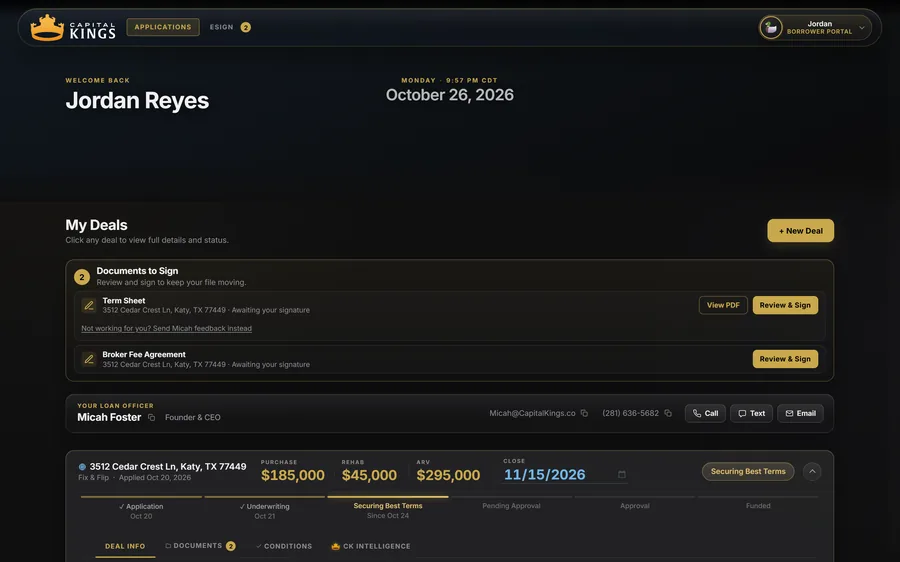
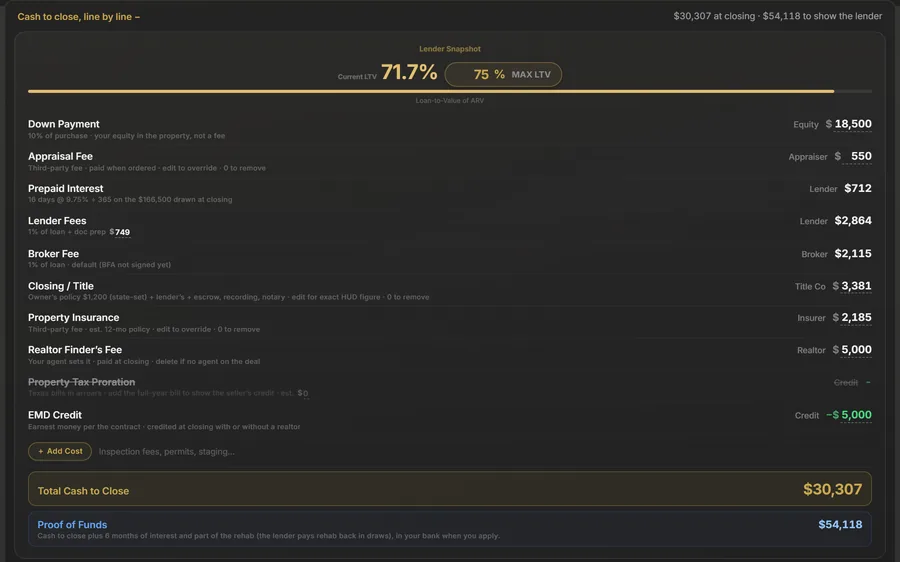
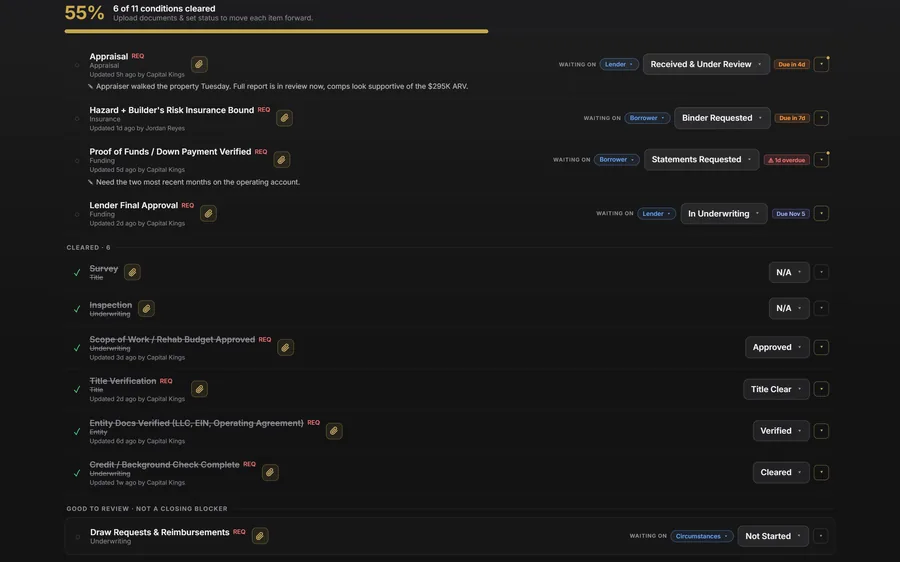
The full walkthrough is on how it works, and you can tour the borrower portal before you apply.
What we fund in New York City
Fix and flip
- Rates
- from 9.50% at 620+ credit with 2+ completed flips
- With experience
- 0% down with 2+ completed flips, purchase plus rehab under 70% of ARV
- Rehab
- 100% funded, paid in draws
Rental (DSCR)
- Qualify on
- the rent, no W-2s or tax returns
- Down
- from 20% at 700+ credit
- Good for
- buy-and-hold, and the refinance when a flip becomes a rental
New construction
- Rates
- from 8.49% with 5+ completed builds
- First build
- 85% of cost with a GC who has 5+ builds
- Builds
- single family to small multifamily
Where we lend in New York City
We broker deals across the whole New York City market. The submarkets investors ask us about most are Wakefield and Williamsbridge, the Bronx (10466 / 10467), Jamaica, St. Albans and Springfield Gardens, Queens (11434 / 11412 / 11413), East Flatbush and Canarsie, Brooklyn (11203 / 11236), Bedford-Stuyvesant, Brooklyn (11221 / 11233) and Mid-Island and North Shore, Staten Island (10306 / 10314 / 10310).
How long does a New York City loan take to fund?
You send the address, purchase price, rehab budget and your ARV, which takes about five minutes and no credit pull. We take it to the lenders in our network that fit it and are licensed in New York, and the rate, origination, leverage and cash to close come back side by side. Plan on 7-14 days with completed flips and 21-30 days on a first flip. We stay on the attorneys, title and the lender through funding.
New York City hard money FAQ
Do you lend hard money in New York City?
Which fix and flip programs apply in New York City?
How fast can a New York City hard money loan close?
How much do I need to bring to close on a New York City flip?
Do you fund the rehab budget in New York City?
What credit score do I need for a New York City fix and flip loan?
Can I refinance a New York City flip into a rental loan?
Can I use a hard money loan on a two-family in the Bronx, Queens or Brooklyn?
What does New York City’s lead law mean for a flip?

What to read before you sign a term sheet
- Points, fees & rate: how to compare hard money lenders
- How construction draws and the rehab holdback actually work
- Dutch vs standard interest: what it really costs you
- Cash to close on a flip: the number most investors miss
Hard money near New York City: Yonkers, Albany, Stamford and Hauppauge. More New York city guides: Buffalo, Rochester and Syracuse. Or see everything we fund in New York.
Ready to fund your New York City deal?
Submit your scenario in about 5 minutes. We shop it and come back with real terms, not a generic rate sheet.