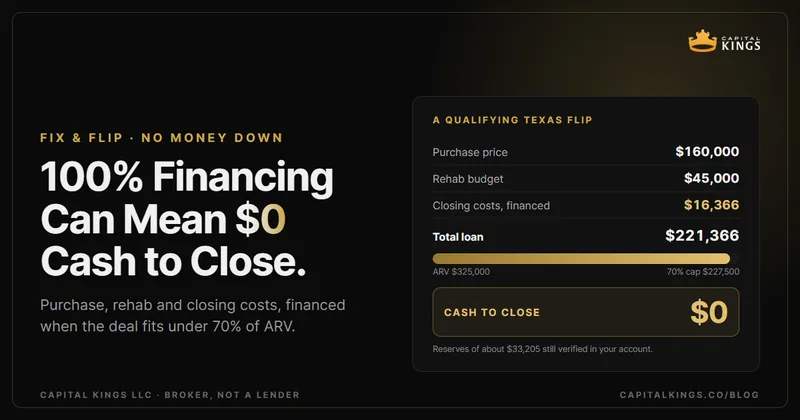
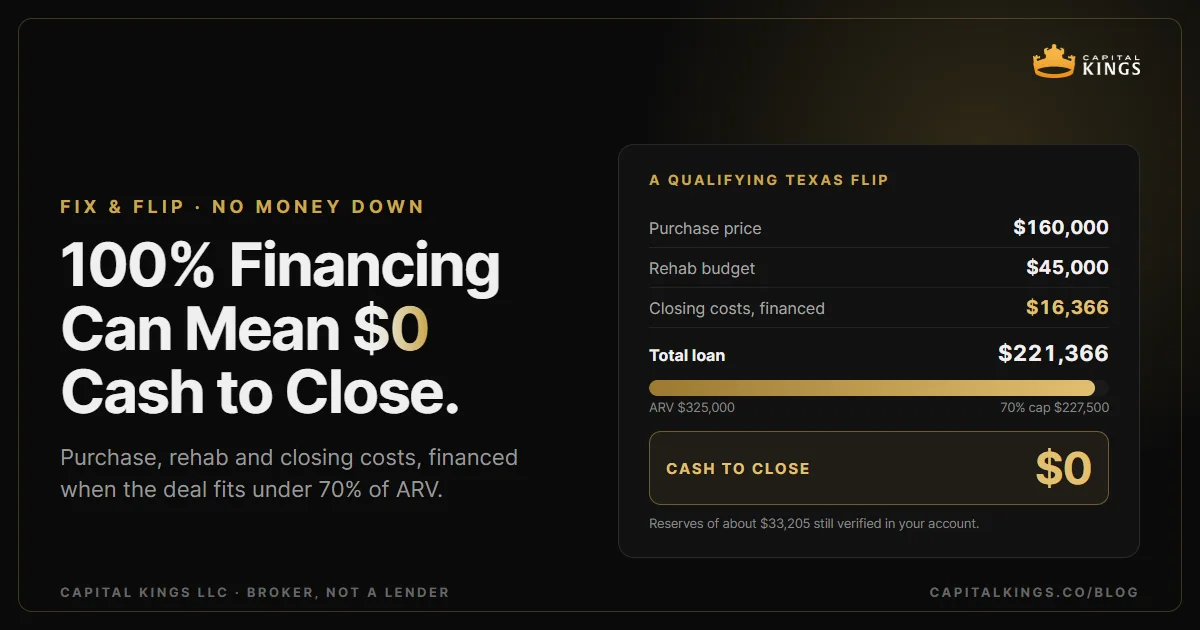
"100% financing" is real, and I broker it. On the right Texas deal it means exactly what it sounds like: the lender pays for the purchase, the rehab and the closing costs, and you bring $0 to closing. The catch is what makes a deal qualify, so here's the plain version, with the numbers.
Quick answer: 100% financing pays for 100% of the purchase price and 100% of the rehab, as long as the loan stays under 70% of the after repair value (what the house is worth once the work is done). It runs 11.50% with 3 points, there's no credit minimum, first-time investors qualify, and it's available in the major Texas metros. When the deal leaves room under that 70% cap, the closing costs roll into the loan too, and you bring $0 to closing. You still show reserves in the bank: your cash to close plus 15% of the loan.
What 100% Financing Actually Is
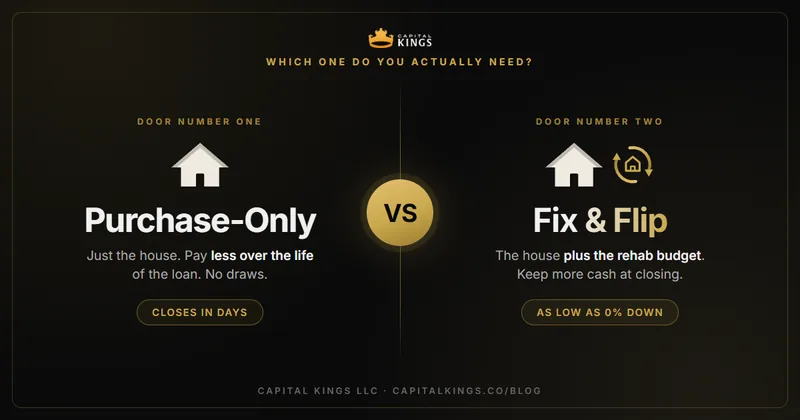
On a normal fix and flip loan, you put money down on the purchase and the lender funds the rehab through draws (payments released as the work gets done). On the 100% financing program, the lender funds the purchase too. You don't make a down payment on the purchase, and you don't put your own cash into the rehab.
The whole program comes down to one number: the loan can't be more than 70% of ARV. Every other fix and flip program I broker goes to 75%. That five point difference is what you give up for the extra leverage, and it decides whether a deal fits before anything else does.
The other cost is the rate. The program is 11.50% with 3 points of origination, and on larger loan amounts the origination can come down to 2.5 points. My 5% down program starts at 9.99% with 2 points. The lender is taking on a borrower with none of their own money in the deal, and they charge for that.
How a Deal Gets to $0 Cash to Close
Let's use round numbers. Say you're buying a house in Houston for $160,000 with a $45,000 rehab and a $325,000 ARV. Purchase plus rehab is $205,000, and 70% of $325,000 is $227,500, so the loan can go as high as $227,500.
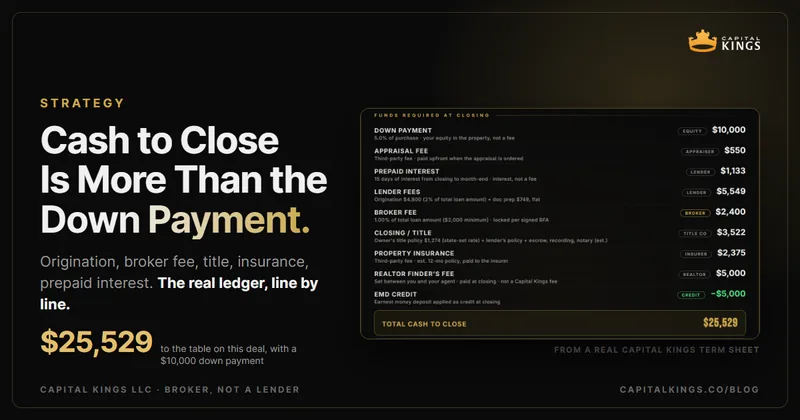
The closing costs on that loan come to $16,366: 3 points of origination, the broker fee, Texas title, insurance, the appraisal, document prep and prepaid interest. They grow a little as the loan grows, and the lender folds every one of them into the loan because the total stays under 70% of the ARV. You bring $0 to closing.
$0 to close is not $0 in the bank. The lender still verifies reserves before it funds: 15% of the loan, about $33,205 on this deal, sitting in your account. None of it gets spent at closing, but it has to be there, and you'll want cash on hand for rehab work before each draw reimburses you. On this deal there's still $6,134 of room under the cap, so some of the monthly interest can be escrowed into the loan too (more on that below).
When the Deal Doesn't Fit Under 70%
Now take the same house with a $280,000 ARV instead. Purchase plus rehab is still $205,000.
So "no money down" on the $280,000 version really means $9,000 down before you count a single fee. Push the ARV to $300,000 and the cap becomes $210,000, so the gap disappears and about $5,000 of the closing costs roll into the loan. Push it further and they all roll in. Whether a deal is really zero down, and zero to close, comes down to the ARV.
What Still Wires at Closing
Leverage changes your down payment. It doesn't change what the closing costs are, and on 100% financing a few of them actually go up, because the loan is bigger and so are the points. What changes is who pays them at the table.
- Origination: 3 points on the loan amount. On a $196,000 loan that's $5,880.
- Broker fee: 1% of the loan, $2,000 minimum, $10,000 maximum.
- Texas title: the owner's policy, the lender's policy and escrow, about $3,300 on a deal this size.
- Builder's risk insurance: in place before closing, about $1,950 on a house like this (0.95% of the purchase plus the rehab for a year).
- Appraisal and document prep: about $550 and $749.
- Prepaid interest: from the closing date to the end of the month, at the loan's interest rate, on the full loan.
Can closing costs roll into the loan? Yes, in the major Texas metros, up to the cap. The lender I use most for 100% financing funds the purchase, the repairs and the closing costs, as long as the whole loan stays at or under 70% of the after repair value. Every dollar of room under the cap after purchase plus rehab goes to closing costs first. Enough room and you bring $0; some room and you bring the rest; no room, like the $280,000 deal above, and you pay them at the table. The instant term sheet does this math for you.
Can the monthly payments be financed too? Yes, when the deal has the equity for it. If there's still room under the 70% cap after the closing costs roll in, the lender can escrow monthly interest payments into the loan at closing (an interest reserve), so the payments while you hold the house don't come out of your pocket either. How many months depends on how much room is left, and it isn't automatic: I set it up deal by deal, so ask me when you apply.
Then the lender checks your reserves: 15% of the loan, verified in your bank statements, and a 401(k) counts at half its vested balance. None of it leaves your account, but it has to be sitting there.
100% Financing vs 5% Down on the Same Deal
Same house, same rehab, same ARV, and the same borrower: a first flip with 700-759 credit. The only thing that changes is the program.
| Line | 100% financing | 5% down |
|---|---|---|
| Max loan to ARV | 70% ($196,000 cap) | 75% ($210,000 cap) |
| Loan amount | $196,000 | $197,000 (95% of purchase plus all rehab) |
| Down payment or gap | $9,000 gap | $8,000 down |
| Rate | 11.50% | 11.74% |
| Origination | 3 points, $5,880 | 2 points, $3,940 |
| Broker fee | $2,000 | $2,000 |
| Title, insurance, appraisal, lender fees | $6,551 | $6,647 |
| Prepaid interest, to month-end | $714 | $733 |
| Estimated cash to close | $24,145 | $21,320 |
| Monthly interest, full loan | $1,878 | $1,927 |
On this deal, where the 70% cap leaves a $9,000 gap, the borrower who picked "no money down" brings about $2,800 more to closing than the borrower who put 5% down, and pays about $50 less a month while holding the house (11.50% against 11.74%). That's the one case where 5% down wins on cash: a deal that doesn't fit under 70%.
Now give the same house a $300,000 ARV. The cap becomes $210,000, purchase plus rehab is $205,000, and the lender rolls $5,000 of the closing costs into the loan. 100% financing comes to about $10,800 to close against about $21,300 on 5% down, roughly $10,500 less cash, and a little more room under the cap takes it all the way to $0, like the $325,000 deal at the top. What 5% down still wins is fees: about $2,500 less on this deal, because 2 points on a smaller loan beat 3 points on a bigger one, and once you've finished a flip with 760 or better credit its rate drops to 9.99%. That's why I often recommend 5% down to new investors who have the cash. If cash is what's tight and the deal fits, 100% financing gets you in with the least. These are estimates; your term sheet shows the exact figures.
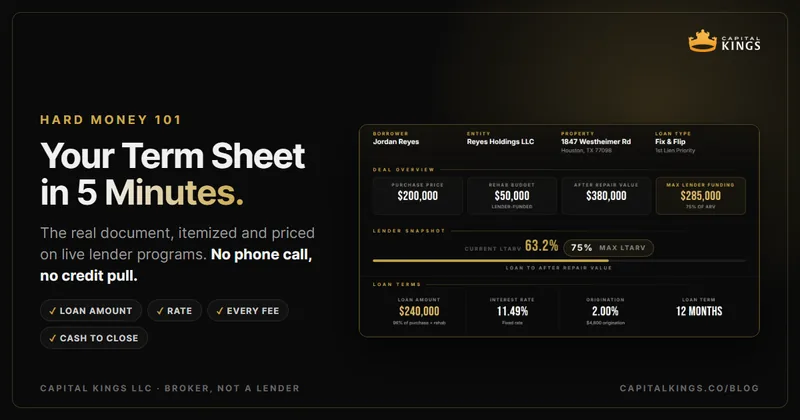
It opens on the $325,000 deal from above, where 100% financing is $0 to close. Try pulling the ARV down to $280,000: the room under the 70% cap disappears, the closing costs come back to the table, and that's where 5% down starts to win on cash.
The 5% Down Option I Steer People To
It lends up to 75% of ARV at 2 points, with a rate between 9.99% and 12.99% that gets better as your credit and experience improve. You need at least a 590 credit score, and no experience is required. A lot of first-time flippers in Houston, Dallas, Austin and San Antonio who have the cash end up on this program, because the fees at closing are lower and the 75% cap leaves more room if the appraisal comes in light.
If the cash is the hard part, that's what 100% financing is for. It has no credit minimum (from 11.50%), and when the deal fits under 70% of ARV it's the lowest cash to close of anything I broker.
Where These Programs Work
In Texas, both the 0% and 5% down programs are only available inside a Texas metro area (MSA): Houston, Dallas, Austin, San Antonio and the smaller metros. A house in a rural county goes to different lenders on different terms, usually with more down and a lower ARV cap. If you're not sure whether your address counts, the term sheet will tell you in about five minutes. The Texas program, with a worked 100% financing scenario that fits under 70% of ARV priced through the term sheet, is on the 100% financing in Texas page.
Outside Texas, 0% down is a different program with stricter rules. You need 2 or more completed flips in the last two years, 620+ credit, about $75,000 in verified liquidity and an LLC, and purchase plus rehab still has to fit under 70% of ARV. It runs 9.50% to 12% plus points, lends in every state I broker in except Alaska, and you still bring closing costs. A first flip outside Texas starts at 10% down, 3 or more completed flips gets you to 7.5%, and 5% down takes 5 or more.
When 100% Financing Is the Right Call
It's the right call when:
- You want to keep your cash. When the deal fits with room under the cap, the closing costs roll in and you bring $0.
- You've got two or three deals under contract and want to spread your cash across all of them instead of parking it in one.
- The ARV is strong enough that the 70% cap doesn't leave a gap, so the only extra cost is the rate and points.
- You've run the monthly holding cost at 11.50% against how long it'll take to sell, and the profit still works.
It's the wrong call if you can't show the reserves: the lender verifies your cash to close plus 15% of the loan in your account. And if the deal doesn't fit under 70% of ARV, the gap is a down payment either way, so run it both ways first.
Two Things I Will Not Tell You
I won't promise $0 to close on a deal that doesn't have the room. In the major Texas metros the closing costs roll into the loan automatically whenever the whole loan stays at or under 70% of ARV, and when they all fit you bring $0. When the deal is tighter, you bring the part the cap can't cover. Either way you show reserves, and the instant term sheet tells you which case you're in before you talk to anyone.
I won't sell you cross-collateralization. Putting up another property you own instead of cash does exist in this industry, but I've never closed one, so I don't advertise it. When someone asks, the honest answer is the 5% down program or a smaller first deal.
See Your Real Number
The calculator above is an estimate. The instant term sheet on the application prices your actual deal both ways before anyone calls you. If it fits under the cap and you still want the leverage, I'll place it. If 5% down comes out ahead, the sheet will show you that too. And if you want to know what happens once that sheet is in your hands, the whole road after you apply is laid out step by step.
Frequently Asked Questions
Is 100% financing on a fix and flip real?
Does 100% financing mean $0 cash to close?
What credit score do I need for a no money down hard money loan?
Is the 5% down option cheaper than 100% financing?
Where is 100% financing available?
Can I use another property as collateral instead of cash?
Want to see both programs on your deal?
The 100% financing and 5% down programs are priced side by side on the fix and flip loan page, on the same house, so you can see which one actually costs you less at closing. Or run your own deal through the instant term sheet and compare them in about five minutes.
Compare them on my deal