Strategy, market intel, and financing breakdowns to make your next deal easier and cheaper to fund.

Send us a borrower and every loan they ever close with us pays you $500. Why that is legal here and almost nowhere else.

Your rehab budget is not funded at closing. How the holdback works, the draw-by-draw process, what it costs, and how to read your HUD.

Every document you need, the 11 conditions a fix and flip file clears, and which four are actually yours.

Real Houston numbers on the two loans hiding under the hard money label, and the cash-at-closing trade most lenders never explain.

Non-QM loans skip the W-2 and tax return requirements of conventional lending. Here's exactly how they work, and when they beat conventional.
The questions direct lenders won't answer unless you ask, what brokers actually cost you, and the long-term play most investors don't know about.
When fast, flexible hard money wins and when a conventional loan is the smarter play. The real trade-offs on speed, cost, terms, and qualification.
Real estate is not one career, it is a dozen. The skills transfer, the paths are flexible, and the long-term wealth case is real.
A repeatable framework for evaluating acquisition price, rehab cost, ARV, and profit margin before submitting an offer.
A 10% rate with 2 points is not the same deal as 11% with 0 points. Here's how to do the real math before you commit.
One charges you on the full loan from day one. The other only on what you draw. Run the numbers and see which structure protects your margin.
Cost structures, timelines, and risk profiles of new construction vs. heavy renovation, broken down side by side.
If your rental covers 1.25x its debt payment, you may qualify. No personal income verification needed.
The classic fix-and-flip formula gets you in the ballpark, but experienced investors know when to use it and when to ignore it.
Speed comes from asset-based underwriting vs. borrower-based. Understanding this sets the right expectations with sellers.
After-Repair Value drives everything in hard money: your loan size, your LTV, and your ability to get to the closing table.
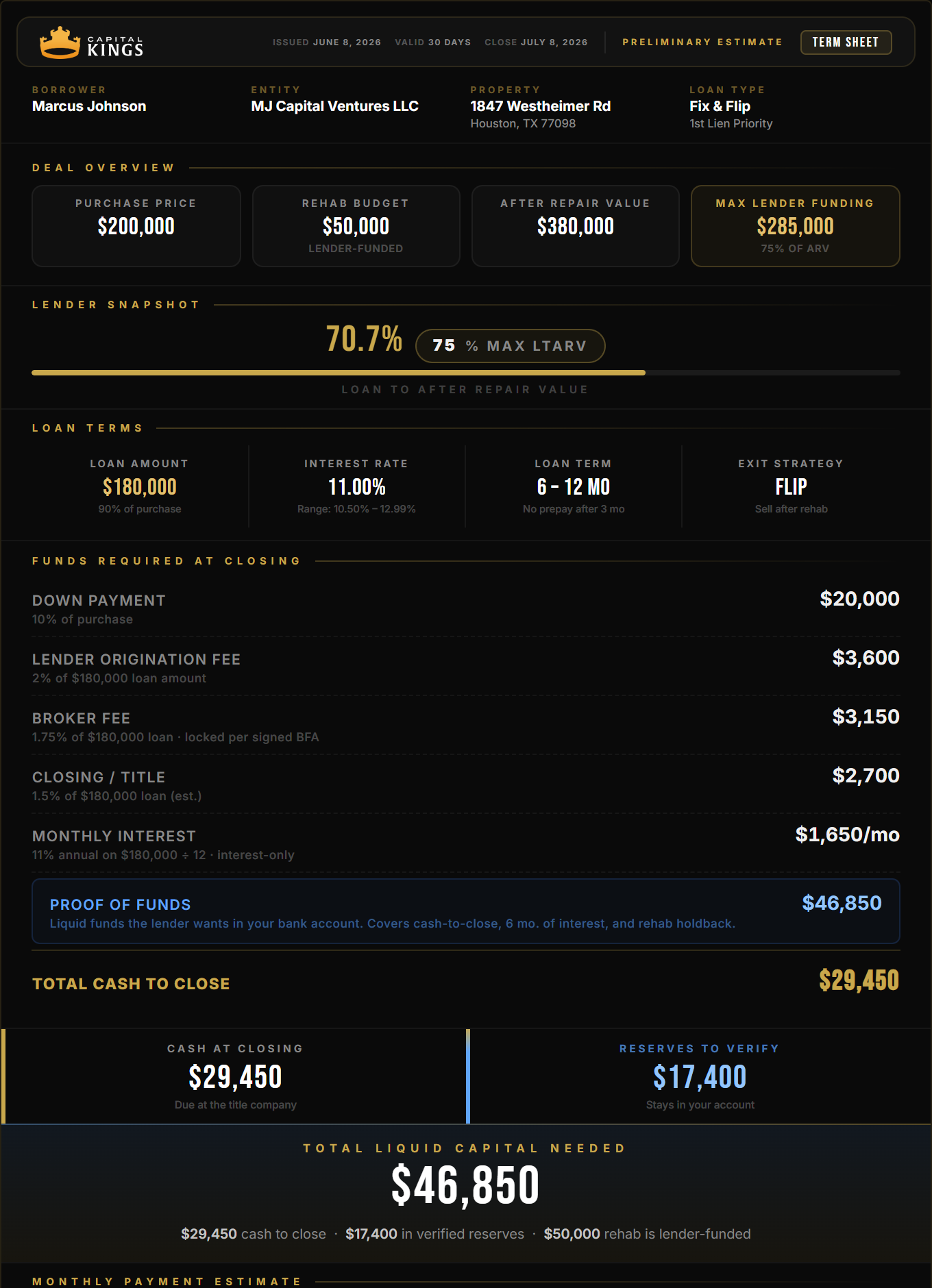
Cash to close is more than a down payment. Here is how it is really calculated, what stacks on top, and the number that catches new investors off guard.
 Investor Insights